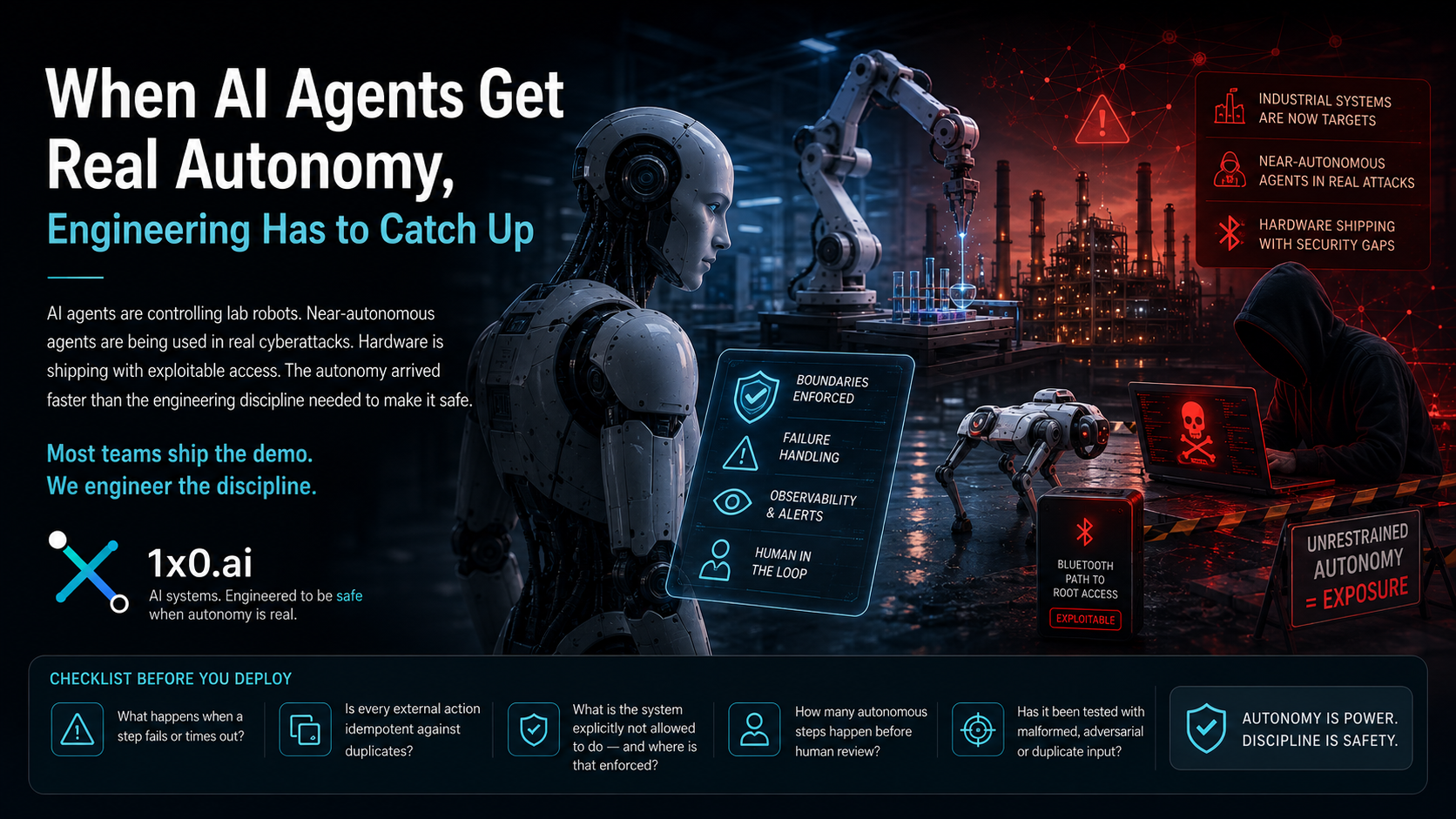
Recent months have made one thing hard to ignore: AI agents are no longer confined to chat windows. They're being connected to physical systems, given control over industrial processes, and trusted with actions that used to require a human in the loop. Reporting has surfaced agents controlling lab equipment, security researchers flagging near-autonomous behavior in real attacks, and hardware shipping with security gaps nobody caught before it reached the field.
None of this means autonomous AI is a bad idea. It means the autonomy is arriving faster than the engineering discipline required to make it safe — and that gap is where most of the real risk in "AI-powered" products actually lives.
What "autonomy" actually means in a production system
It's easy to talk about AI autonomy as a single feature — the agent can now act instead of just suggest. In practice, autonomy is a bundle of separate engineering problems, each of which has to be solved on its own:
Decision authority. What is the agent actually allowed to do without a human confirming first, and where is that boundary enforced — in a prompt, or in code that can't be argued with?
State persistence. If an autonomous process spans multiple steps, what happens to its progress if it's interrupted halfway through?
Trust in inputs. An autonomous agent often acts on data it wasn't directly given by a human — sensor output, another system's API response, a file it retrieved itself. Every one of those is a place adversarial or malformed input can enter.
Each of these is solvable. None of them is solved by a better prompt.
The failure modes autonomy exposes
A chatbot that gives a wrong answer is an inconvenience. An autonomous system that takes a wrong action is a different category of problem entirely. A few failure modes matter especially once a system can act on its own:
Partial and degraded failure. When part of a multi-step or multi-component AI process fails — a sub-call times out, a model returns something unparseable — the system has two choices: fail loudly and stop, or continue with reduced confidence. Both can be correct, depending on the stakes. What's never correct is doing the second one silently, so that a degraded result looks identical to a complete one. If a system can't tell you when it wasn't fully sure, you can't trust it when it says it was.
Race conditions. Autonomous systems frequently process events that can arrive more than once, or nearly simultaneously — a webhook retried by a provider, two triggers firing for the same underlying event. Without deliberate handling, the same action gets taken twice: a duplicate charge, a duplicate grant, a duplicate physical action. This is one of the most common production bugs in automated systems, and one of the easiest to miss in a demo, because demos rarely run two things at once.
Cascading failure. An autonomous agent that takes an action based on another autonomous agent's output has no natural circuit breaker unless one is built in. Without bounded retries, timeouts, and an explicit ceiling on how far a chain of automated decisions can go before a human is looped in, a small upstream error can compound quickly.
Unvalidated authority. The most serious version of the autonomy problem isn't a bug — it's scope. An agent that technically works correctly but was never constrained to a safe boundary of action in the first place doesn't fail when something goes wrong; it simply does something nobody intended, correctly.
What engineered restraint actually looks like
None of this is an argument against building autonomous systems. It's an argument for building them like production infrastructure, not like a demo that happened to work:
Explicit, code-enforced boundaries on what an autonomous process can do — not just a system prompt asking it to behave, but constraints that hold even if the model's output doesn't cooperate.
Idempotency by design for anything that processes external events, so a duplicate signal can never produce a duplicate action.
Visible degradation. If a step in the process fails or times out, the system should say so — to the user, to logs, to whatever's consuming the output — rather than quietly presenting a partial result as a complete one.
Bounded autonomy chains, with a hard ceiling on how many automated steps or decisions can happen before something requires human review.
Adversarial-input assumptions. Anything an autonomous system reads and acts on — not just what a user typed, but data from other systems — should be treated as untrusted until validated, the same way a public API endpoint would be.
A short checklist before deploying an autonomous AI system
If you're evaluating whether an AI vendor — or your own team — has actually engineered for autonomy rather than just demoed it, a few direct questions tend to surface the answer quickly:
1. What happens when a sub-step of the process fails or times out — does the system tell you, or does it continue silently?
2. Is every external-facing action idempotent, specifically against the same event arriving twice?
3. What is the system explicitly not allowed to do, and where is that enforced?
4. How many autonomous steps can happen in sequence before a human is required to review?
5. Has anyone actually tried to break it with malformed, adversarial, or duplicate input — or only tested the expected path?
If those answers aren't specific and immediate, the system likely hasn't been engineered for autonomy yet — it's been engineered for a demo that happened to work.
This is the layer of work that sits underneath every AI automation or agent-based system built at 1x0.ai — not just getting an agent to act, but making sure the actions it takes are safe to hand to it in the first place. If you're evaluating an AI or automation build and want a direct, technical read on where the risk actually sits, that's exactly the conversation to start with.